

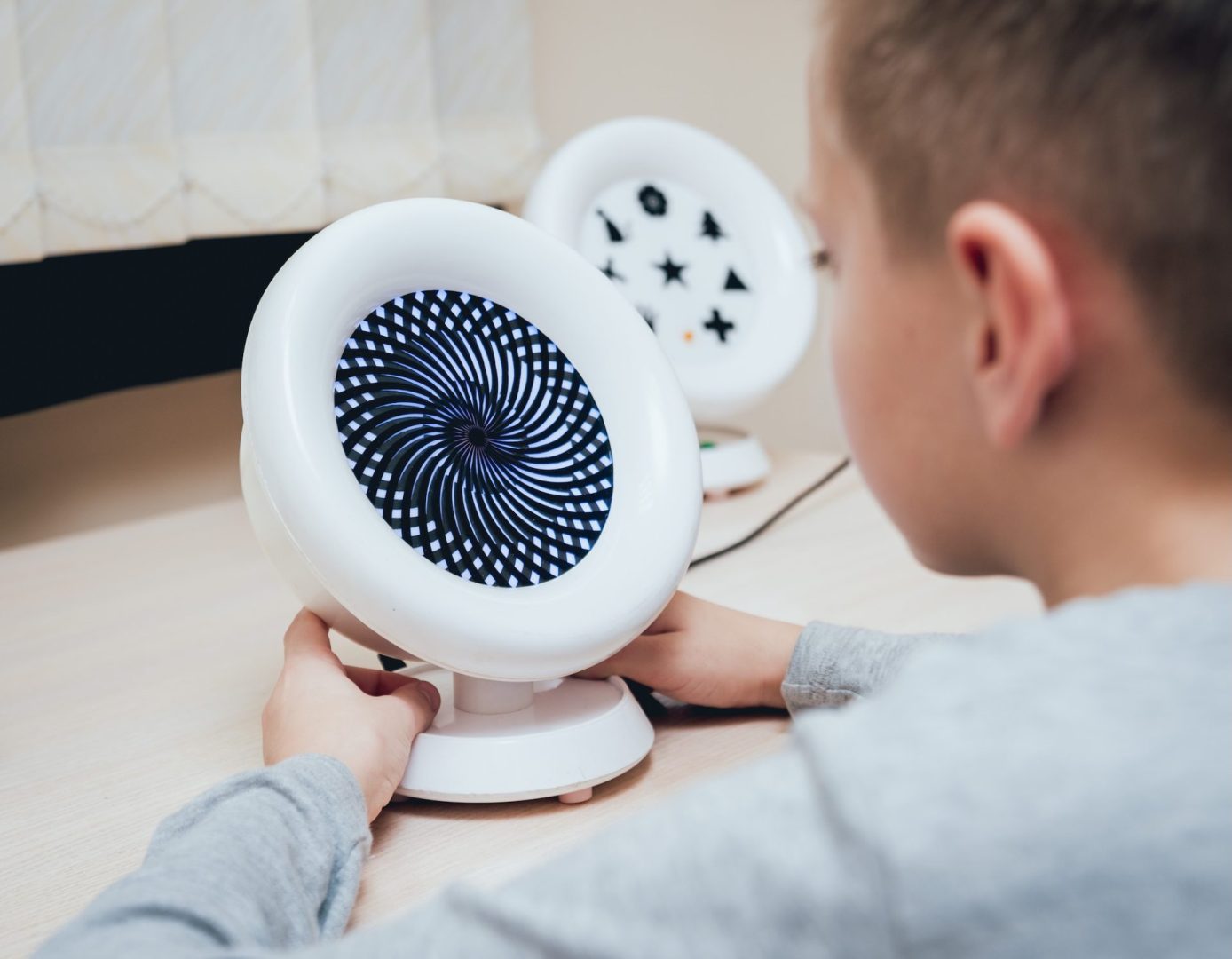
Your eyes work hard, but sometimes they miss the mark. When your vision is working poorly—or not as well as it could–vision therapy can help. Our optometrists are known as behavioral optometrists, meaning they have received training and education focusing on visual performance and function. We perform a comprehensive eye exam to assess all areas of the visual system. Then, we can develop a personalized vision therapy program to help support visual development or enhance visual skills.
Skills improved by vision therapy can include:
- Accommodation—controlling focusing distance
- Binocular vision—eye muscle & movement control
- Convergence—inward movement of eyes to allow for near focusing
- Visual motor control—hand-eye coordination
- Visual spatial function—spatial awareness & depth perception
Who Can Benefit from Vision Therapy?
All ages can benefit from vision therapy, and we have programs available for both children and adults.
Children with eye conditions or visual developmental problems may receive vision therapy to help preserve their sight or improve academic performance.
Adults may experience vision impairment because of brain injuries, task-related visual demands, or a lack of visual development. Vision therapy can help restore vision or improve performance, whether you suffer from daily digital eye strain or need a competitive advantage in sports.
The Importance of Measuring Visual Performance
Many people can have excellent eyesight (20/20 visual acuity) but still have poor visual function. Patients or parents may be told that their eyes or their child’s eyes are “normal” because they have 20/20 vision.
Yet, vision function does not end with an assessment of eyesight. A complete evaluation of the visual system includes specific measurements of performance or function. Notably, the visual system is more than the eyes, including neural pathways and parts of the brain.
The Difference Between Visual Acuity & Visual Function
- Visual acuity refers to the overall sharpness of your vision (eyesight). This can be assessed with the use of a Snellen eye chart or phoropter.
- Visual function refers to the mechanisms with which your eyes operate. This includes eye tracking, focusing accuracy, depth perception, and more.
Our optometrists received specialized training and education focused on visual function. We evaluate all areas of the visual system in order to determine if a lack of visual function is impairing performance.
Vision Issues? We Can Help
Our vision therapy programs are tailored to individual needs. The methods can involve exercises, therapeutic tools, specialty lenses, or technology.
In-office exercises can include training through eye movement or using tools like balance boards. We may prescribe specialty lenses, such as prismatic lenses, to help correct eye alignment problems.
The length of the program may vary from person to person, depending on their vision issues or individual response. Our team can help manage and treat various problems affecting healthy vision, including:
- Amblyopia (Lazy Eye) & Strabismus (Crossed Eyes)
- Developmental & Injury-Related Vision Problems
- Learning, Development, & Behavioral Issues
- Sports Vision
- Stress-Induced Symptoms
Undetected eye problems in childhood or adulthood can impact everyday visual tasks. Our team can help evaluate any visual impairment or gaps in development to create a personalized program so you can experience healthier vision.
Book an appointment to see if vision therapy is right for you.
Vision therapy is currently only offered at Vision Care Center – Peoria. More locations coming soon.